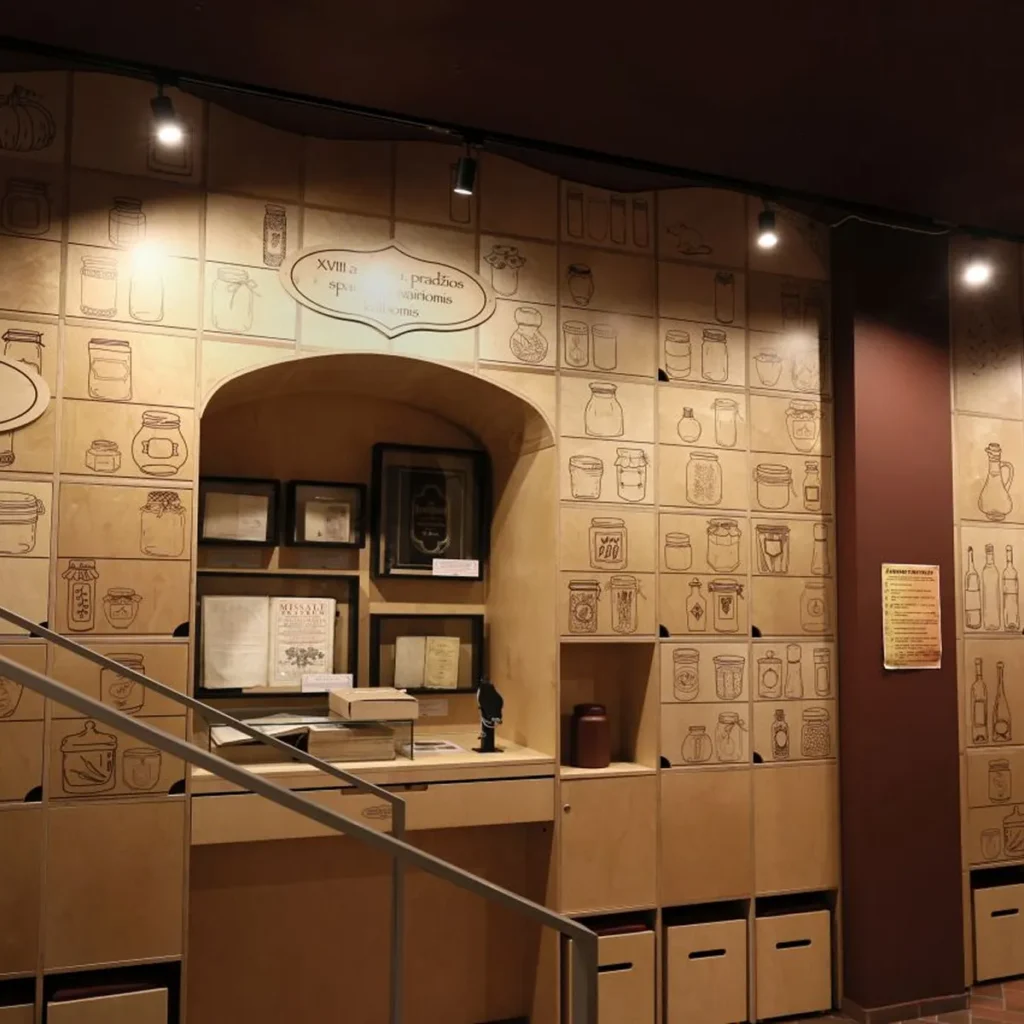
We opened the exhibition “Bitė’s Granaries” in 2021 to commemorate the 160 th anniversary of Gabrielė Petkevičaitė-Bitė. Here, you will get acquainted in an engaging form with the personality of the enlightened, cultural and public figure and writer Gabrielė Petkevičaitė-Bitė, her activities, and values.
Why did we create this space as a granary and name it that way? A granary symbolizes care and motherhood, which was so characteristic of Gabrielė Petkevičaitė-Bitė.
She, as a guardian-mother of the entire Lithuanian nation, especially the younger generation, cared for people: she collected funds for talented students to study, fought for women’s rights, treated the sick people, and educated the entire nation with her writings.
Like in a granary, here we preserve the memory of Gabrielė Petkevičaitė-Bitė and eternalize her values and achievements. Here we also store the treasure trove of old library publications.
The “Bitė’s Wall” in the entryway introduces the writer’s appearance and inner qualities—sensitivity, humanity, and closeness to people. Try the height-measuring tape—on one side you see Bitė’s height, which was determined by a disability, and on the other, the abundance of her achievements, which were not constrained by difficulties.
Here you see a fragment of Bitė’s workroom: books, personal belongings, an impressive table, a chair, a footstool, and a radio. These items came from Bitė’s last home on St. Zita Street in Panevėžys.
The old publications stored in the library are set up in their respective granaries according to topics. They contain old publications, old Lithuanian publications, interwar Lithuanian publications, old publications from the Panevėžys region, old cartographic publications, books with personal bookplates, and examples of bookbinding art.
It is worth noting that each group of publications is associated with a certain food as an expression of motherly care. For example, old publications from the Panevėžys region are linked with interwar sweets, because many of them describe community life and family entertainment, and sweets—candied fruits and sugar candies on sticks—help recreate the mood of those times.
The oldest publication in the exhibition came from as far back as the 17 th century. It is a collection of religious treatises by the Portuguese canonist and bishop Augustinus Barbosa, “Tractatus varii…”, published in 1699 in Lugdunum (now Lyon). One of the most exceptional and oldest books is Konstantinas Sirvydas’s trilingual Polish, Latin, and Lithuanian dictionary “Dictionarium trium lingvarum”.
The library has a special area where books are renewed and restored. Here, a restorer binds books, gluing loose pages or using a special drill to reattach them. He also sews all the annual issues of specific magazines into large volumes. Old vinyl record sleeves are also restored, and up to 100 publications that have been water-damaged or chewed by pets are repaired each year. Visitors can also use lamination and spiral binding services here.
Gabrielė Petkevičaitė-Bitė was a writer and publicist, educator and teacher, public figure and politician, patron and philanthropist, and an initiator of the movement for women’s rights and dignity. This prominent woman is accompanied by numerous other epithets due to her versatile activities. The epicentre of her activities was the Lithuanian nation and the emerging Lithuanian state, a clear and continuous concern for the human being, the nation, and the state. Bitė put all her efforts and will into serving her nation and country.
Gabrielė Petkevičaitė-Bitė is like a mother, “Motulė” (Mummy), to young Lithuania and its children. This association also came from one of the creators of a radio show who described her as a “Miss-Mother”. Her personality is characterized by a nobly graceful, intellectual, and spiritual maternal nature. A caring mother always protects the goods and values that are relevant to her family and children, so that they are accessible whenever required. Bitė also cared for Lithuania and its people as a mother takes care of her children—to ensure they were educated and cultured. She believed that a hungry child cannot learn, therefore, concern for material things was highly important to her.
Exhibition of Old Books
The library, like a “mummy”, also cares for the preservation of old books and introduces these treasures to all visitors.
Currently, the library holds around 40,000 publications published before. Only the most valuable ones are highlighted in this exhibition.
These embrace examples of printing, illustration, and bookbinding skills valued in Lithuania and worldwide; publications from the period of the Lithuanian Press Ban and after it; publications in the Lithuanian language printed outside of Lithuania; periodicals from that time; small publications; interwar press; and publications by printing houses and societies that operated in Panevėžys. A valuable part of the old publications collection consists of books with autographs, dedications from prominent people of the Panevėžys region, and stamps from institutions and bookplates from people who operated in the Panevėžys region.
The oldest book dates back to the 17 th century—it is a religious treatise, “Tractatus varii…”, by the Portuguese jurist Augustinus Barbosa, published in 1699 in Lugdunum (now Lyon). One of the oldest books, the trilingual dictionary in Polish, Latin, and Lithuanian by Konstantinas Sirvydas “Dictionarium trium lingvarum”, is also extraordinary. This book brought from Italy was gifted to the library by the rector of the Berčiūnai Lithuanian Martyrs Church Algirdas Dauknys and restored by the document restorer of the first qualification category Jurgita Stankaitytė.
The oldest book in the Lithuanian language is “Prarakai…”, published in Königsberg in 1754.
A plenitude of publications from the period of the Lithuanian Press Ban and after it is exhibited here.
In the interwar publication granary, you see books, periodicals, graphics, and advertisements from Lithuanian periodicals published in 1918-1940. During the interwar period, more than 300 books for children were published, including creative works by Pranas Mašiotas, Matas Grigonis, Vytė Nemunėlis, and other writers.
The exhibition also covers the oldest publications published in Panevėžys and Biržai, as well as the first regular city newspaper “Panevėžio balsas”.
In the old cartographic publication granary, you can see the Panevėžys city plan drawn up in 1904 and other maps.
In the bookplate exhibition, you can view ex-libris, autographs, dedications, stamps, and other bookplates.
Memorial Exhibition of Gabrielė Petkevičaitė-Bitė
The items from the workroom fragment—personal books, furniture, and other items from Bitė’s last home on St. Zita Street—were lent to us by the Panevėžys Local History Museum.
Among the highest Bitė’s merits, she was a candidate for the president of Lithuania. Bitė ran for president in 1926, when no woman in the world had yet become president, but she received one vote and lost to Kazys Grinius. One of her merits, being “abolitionist”, refers to the US movement against the exploitation of slaves. Bitė carried out such activities in Lithuania, directed against the exploitation of women.