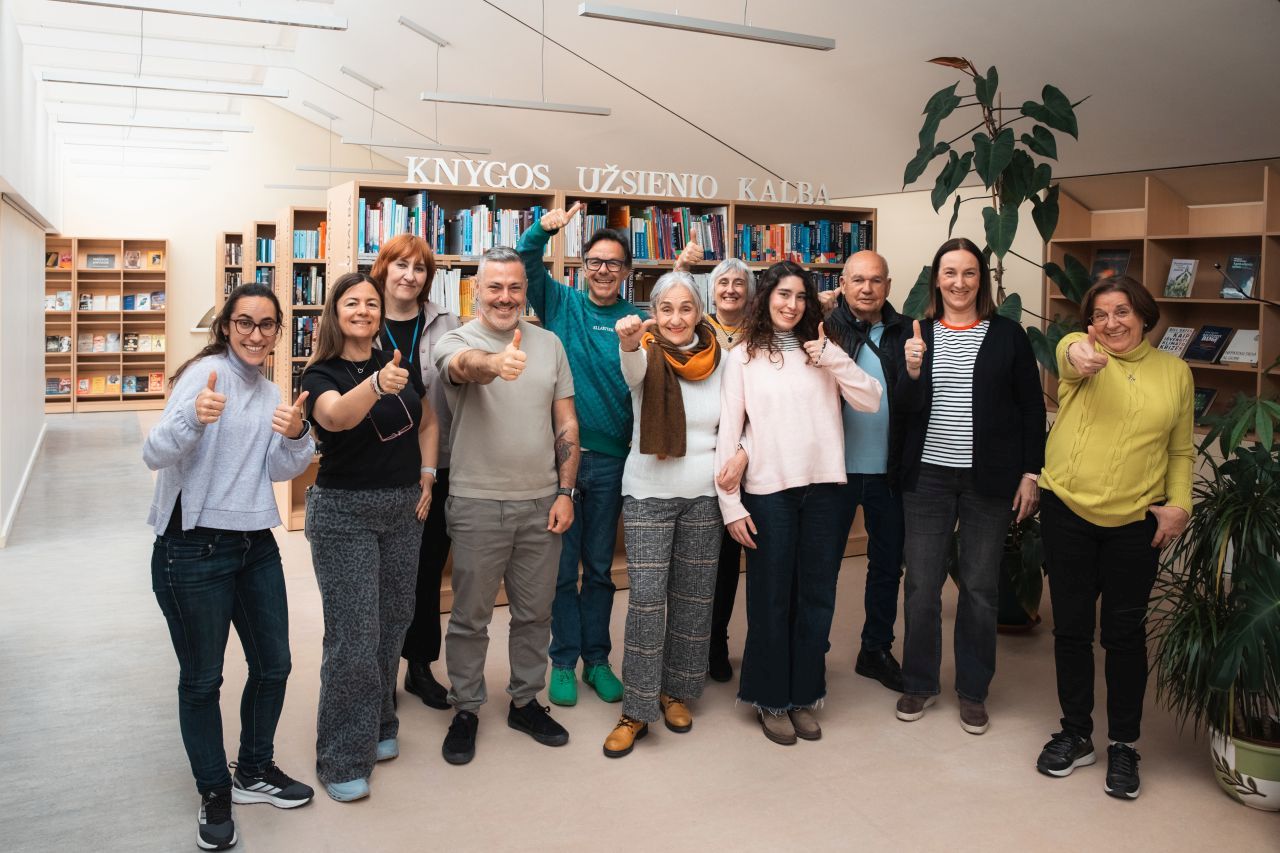
From March 23 to 27, Panevėžys County Gabrielė Petkevičaitė-Bitė Public Library hosted an international Erasmus+ programme visit, bringing together representatives (teachers and adult learners) from three adult language schools in Spain. The guests arrived from the Canary Islands – the towns of Santa María de Guía and Los Cristianos – as well as from the city of Barbastro in northern Spain.
The aim of the visit was to introduce participants to the library’s non-formal adult education activities, with a particular focus on informal English language learning methods, to exchange best practices, and to strengthen international cooperation.
The guests took part in a guided tour of the library premises and were introduced to the work of its departments. They were also presented with the library’s non-formal adult education initiatives, including leisure clubs, training sessions for the public and professionals, cultural events, and adult volunteering activities.
During the visit, participants had the opportunity to get to know the city of Panevėžys better through a guided tour of its main cultural landmarks. They also visited the memorial apartment of theatre director Juozas Miltinis, where they learned how exhibition content can be applied in non-formal language learning.
The main focus of the visit was on practical, informal English language learning. The guests participated in all sessions of the library’s English Conversation Club “Let’s Talk”, both in-person and online, and also joined the Language Café sessions. These activities allowed them not only to observe the methods used, but also to try them out in real learning situations.
A special practical session was also organised for the visitors, giving them the opportunity to experience the methods applied in the library’s language clubs. The session was led by Virginija Švedienė, the librarian coordinating these clubs, who introduced visual thinking, storytelling, reflection, debating, creative writing, and thematic discussions on current topics – methods that have been successfully applied in work with adult learners.
The participants particularly appreciated the impact of these methods. According to them, such approaches help adult learners gain confidence, encourage active participation, and reduce the fear of making mistakes when speaking a foreign language.
On the final day of the visit, the guests were introduced to the results of the Erasmus+ accreditation project implemented by Panevėžys County Gabrielė Petkevičaitė-Bitė Public Library together with twelve public libraries from the Panevėžys region. The presentation highlighted ideas brought back from mobility visits and successfully applied in practice. Future cooperation opportunities between the library and adult language schools were also discussed. One of these includes the involvement of adult learners in the online sessions of the English Conversation Club “Let’s Talk”, thus continuing international communication and learning remotely.
Carlos (teacher at Los Cristianos Adult Language School): “What impressed us the most was how open this library is to the community and the strong sense of community it creates. Running all these clubs successfully requires a great deal of dedication and effort – attracting people, engaging them, and maintaining their interest. It is clear that people enjoy being part of this library’s community. We also greatly appreciate the contribution of volunteers – it is wonderful to see that some clubs, such as the Bitė Book Club, are run entirely on a voluntary basis.”
Eva (Head of Santa María de Guía Adult Language School): “This visit was a great opportunity to see how many different faces Europe has. Your success is not only due to the dedication of your staff, but also to the entire environment – the impressive architecture of the building and the artworks throughout the library. All of this shows how important culture is to you. It is also remarkable that such a small city has four theatres!”
Ricardo (teacher at Los Cristianos Adult Language School): “I really liked your idea of creating a space for young people with a collection of books that may eventually capture their interest. I was also impressed by the importance of the Erasmus+ programme for your new activities – thanks to it, you have brought back and implemented many ideas. We will definitely share our experience with librarians in Spain and encourage them to visit you. Personally, I really liked the format of your English conversation club and I am already thinking about how to apply it in my own work. The informal approach is very important, as it allows learners of different levels to participate in discussions without feeling pressure or fear of making mistakes.”
Estrella (teacher at Barbastro Adult Language School): “I was particularly impressed by how much you trust your community, especially teenagers and young people. They are free to use musical instruments, board games, and technologies. This made me reflect on the fact that perhaps we are sometimes overly cautious and should trust young people more. Then they would understand that a library is not just a quiet space – it can also be a place for engaging and interesting activities. I think I will suggest organising English conversation sessions for young people in my school.”
Jose Luis, Teresa, Rocío, Ana, Esther (adult learners from Barbastro Adult Language School): “We would like to sincerely thank you for your hospitality, the interesting and engaging activities we were able to take part in, and the opportunity to get to know Lithuanian culture through conversations with library visitors. It was very interesting to learn about this type of institution, as libraries in Spain are quite different. This visit broadened our horizons, and we hope to introduce similar non-formal language learning activities in our school. We would also be happy to join your online sessions.”
More and more Erasmus+ participants are choosing our library as a host organisation. This confirms that the results we have achieved in the field of non-formal education are becoming a source of inspiration for other institutions and encourage the development of new activities. Today, more than ever, we can clearly see the benefits of the Erasmus+ programme – it not only enables us to learn from the most advanced non-formal education organisations in Europe, but also allows us to enrich the leisure time of our community members. By involving them in various activities, we give them the opportunity to learn about other cultures first-hand and to experience the joy of learning together.
Virginija Švedienė
Specialist of Educational Activities