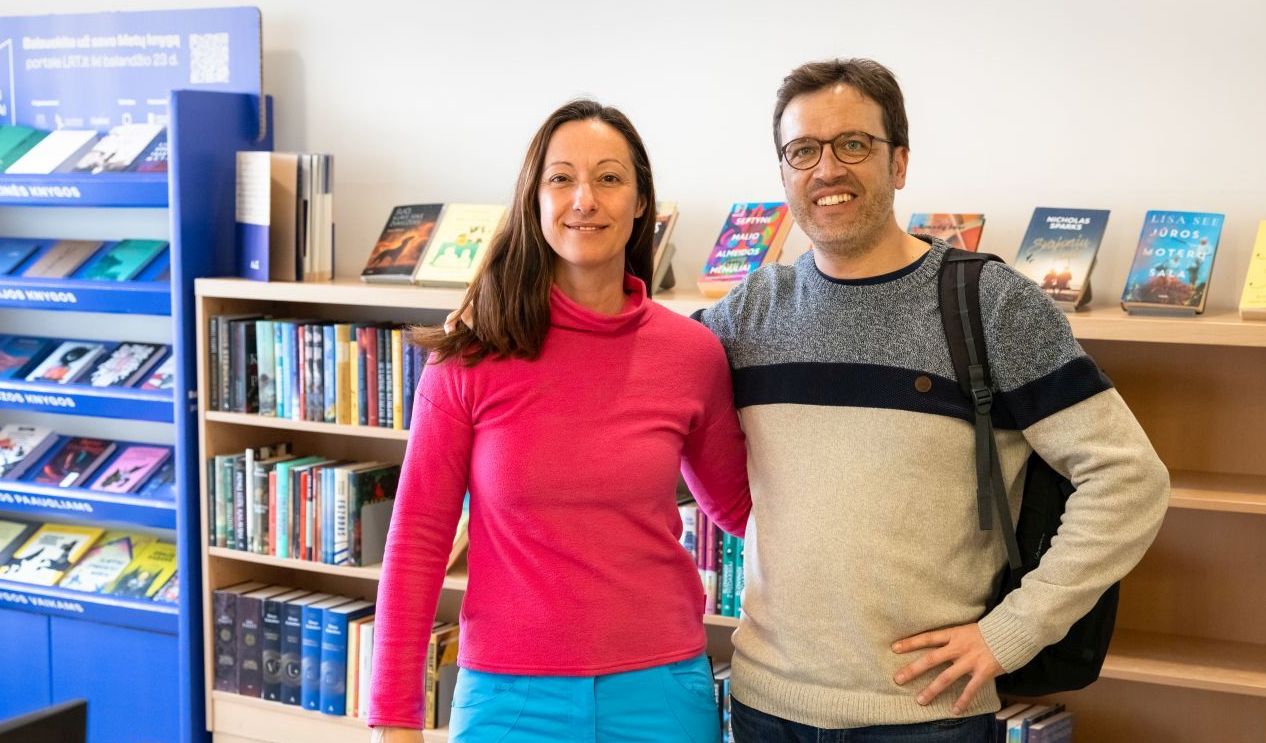
With the Gabrielė Petkevičaitė-Bitė Public Library of Panevėžys County actively participating in Erasmus+ programme activities and implementing an accreditation project in the field of adult education, opportunities for international cooperation are steadily expanding. Not only library professionals from the Panevėžys region, but also library volunteers and adult learners take part in training visits to various adult education institutions across Europe. At the same time, an increasing number of representatives from other countries participating in the Erasmus+ programme come to our library to gain valuable experience and exchange good practices.
On 23–25 February, the library hosted representatives from the Livorno Adult Education Centre (Italy), Luca Signorini and Antonio Tonelli. On 9–13 March, guests from Spain visited the library – Angela Sanchez from the Mardeleva Adult Education Centre and Jordi Soldevilla from the Vallès Oriental School of Languages for Adults. During their visits, the guests became acquainted with the library’s activities, adult education initiatives and ongoing projects, and showed interest in non-formal education methods as well as digital and media literacy programmes. Erasmus+ participants from Italy and Spain also took part in the library’s Language Café and the English conversation club “Let’s Talk”, and met with library volunteers. The visits also included discussions on future cooperation opportunities, as well as the exchange of good practices and insights into adult learning trends in different countries.
What do the guests say about their visit?
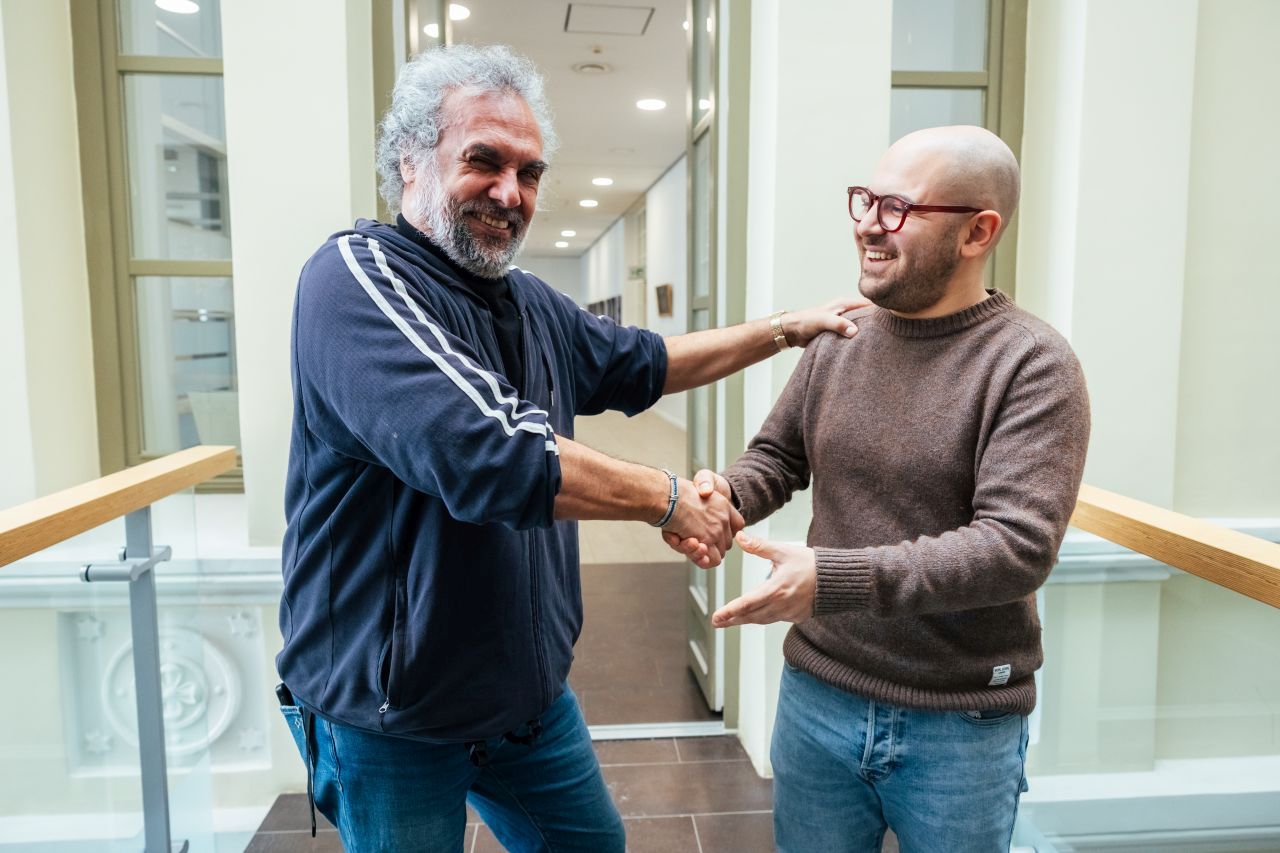
Luca, teacher of Italian language and history: “This was my first Erasmus experience. I knew nothing about Lithuania, but I was very happy to discover a new country and culture, as well as to learn about new teaching and learning methods. I will return home with new knowledge and skills. The library left a huge impression on me – it is not only spacious, but also impressive in its activities: many different training sessions take place here, leisure clubs are active, and cultural events are organised. Thank you for the wonderful reception and the excellent presentation of your activities. I would very much like to come back again.”
Antonio, teacher of mathematics and natural sciences: “This was also my first Erasmus experience. I sincerely thank you for the warm welcome and friendliness. I was deeply impressed by the dedication of the people working here. I will return home with a wealth of new knowledge. Although your library and our adult education centre are quite different institutions, I am sure I will be able to apply the methods I learned here in my work.”
Angela, head of an adult education centre: “Thank you sincerely for the perfectly organised visit programme – my expectations were even exceeded. I was greatly impressed not only by your library staff, but also by the belief of the people I met in Lithuania in the importance of culture and social connections – this is clearly the foundation of your activities. It is wonderful to see that volunteers actively contribute to non-formal adult education. The activities of leisure clubs go beyond the library itself – people become friends, expand their social networks and participate together in the cultural life of the town. I am taking away many valuable ideas – I will definitely bring together a group of our learners to participate in virtual meetings with your “Let’s Talk” club members. I was also interested in how spaces are adapted to visitors’ needs – a great example is the cosy periodicals reading room on the ground floor, adapted for seniors. The children’s department impressed me with its creative solutions – technology, education and reading promotion initiatives are perfectly combined here. It is inspiring how you bring life and meaning to your library by focusing on people’s needs.”
Jordi, head of the English department at a school of languages for adults: “I sincerely thank you for the opportunity not only to learn from you, but also to get to know the cultural life of the town. One of the highlights of the visit was the visit to the Juozas Miltinis Memorial Apartment, which allowed us to feel the uniqueness of the legendary director and his importance to the town. The visit to the library was extremely valuable, even though I represent a formal education institution. Non-formal language learning methods – discussions, analysing controversial statements, and group problem-solving – will certainly be applied in our teaching process to better motivate learners. For more than a year now, our students have been participating together with members of your English conversation club in a joint initiative, organising virtual meetings on various topics. I plan to encourage them to join your weekly meetings, as such international experience not only improves language skills but also broadens cultural awareness. I am also very grateful to Jūratė, a volunteer of the Bitė Book Club, for her useful advice – it will be helpful when planning a book club in our school. We are aiming for changes in the library field as well, and your example clearly shows that the most important thing is not only the space, but also the spirit of community. You are a true community centre, and that is truly inspiring.”
A library connecting countries and communities
The Gabrielė Petkevičaitė-Bitė Public Library of Panevėžys County is steadily strengthening its position in the European adult education landscape and is becoming increasingly visible and recognisable in the international context. The growing number of cooperation partners shows that various formal and non-formal adult education institutions are increasingly choosing the library not only as a reliable host organisation, but also as a competent partner from which to gain valuable professional experience, innovative methods and examples of good practice. These visits also contribute to the strengthening of the international dimension of the library’s activities – book clubs and language learning clubs have gone beyond the physical walls of the library and even the national context. Joint virtual discussions of literature are held between the library and book clubs from other countries, while members of language clubs have been participating in online sessions since 2020, joined by participants from Spain, Italy, the USA, Slovenia and other countries. Such an international context provides participants not only with opportunities to improve their language skills, but also to broaden their cultural horizons, develop intercultural competences and strengthen a sense of community in a global environment.
Photos by Gintaras Lukoševičius
Virginija Švedienė
Specialist of Educational Activities